
Reading A Timber Fence: What Is Failing And Why
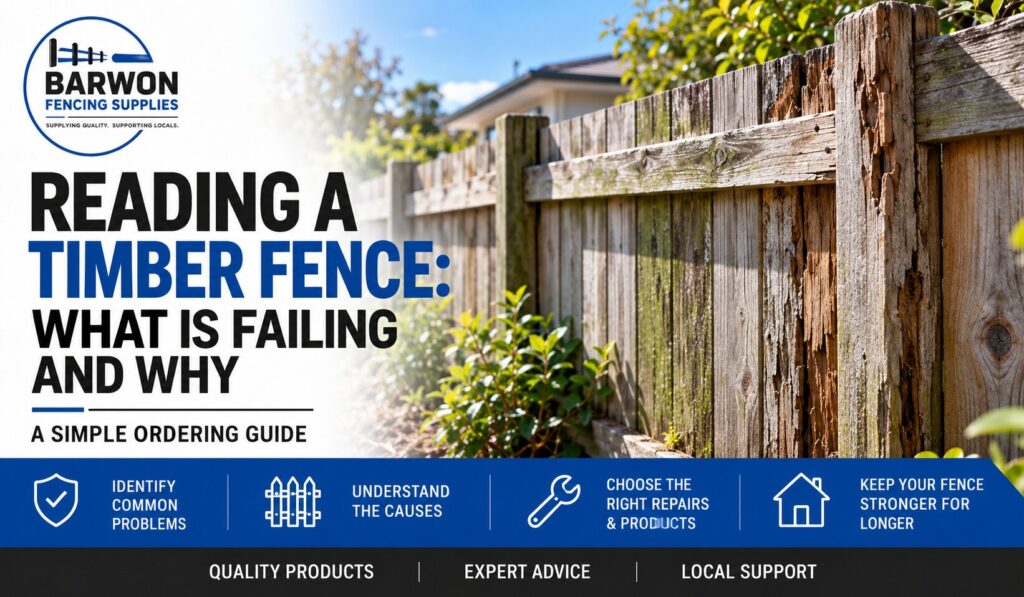
A timber fence rarely fails all at once. It gives you years of warning, usually in the same order, and most of those warnings are fixable if you catch them early enough.
The problem is that the warnings are easy to misread. People replace palings when the post is the problem, or oil a fence that is failing underground where oil cannot reach.
Almost everything starts at the soil line
Of the three components in a fence, palings, rails and posts, the posts carry the risk. Specifically, the few centimetres of post right at ground level.
That band is where moisture and oxygen are both present in quantity, which is exactly what fungal decay needs. Timber fully buried has limited oxygen. Timber well above ground dries out. The interface between the two does neither, and it is where a fence will almost always let go first.
Two standards people constantly confuse
This is the single most useful thing to understand about timber, and it explains a lot of premature failures.
Natural durability is rated under AS 5604, in classes 1 to 4, with class 1 the most resistant. It describes how the timber itself resists decay and insect attack with no treatment at all.
Hazard class is a completely different thing, set out in the AS/NZS 1604 series as H1 through H6. It describes the preservative treatment applied, matched to the exposure the timber will face. H3 is outdoors above ground, which suits palings and rails. H4 is in ground contact, which is what fence posts need. H5 covers severe in-ground and structural work such as retaining walls.
A durable timber is not automatically suitable in the ground, and a treated timber is not automatically suitable everywhere. Ratings also change with use. Spotted gum rates class 1 above ground but class 2 in ground, which is the same timber judged on two different jobs.
The heartwood catch
Natural durability ratings apply to heartwood only. The paler sapwood on the outside of a board has effectively no natural durability regardless of species, and it needs preservative treatment to perform.
This is why a hardwood fence can still rot. If the boards carry a good proportion of untreated sapwood, the species rating on paper means very little in practice.
The treatment stamp is the only reliable indicator of where a piece of timber can be used. If a post is not branded for in-ground use, it does not belong in the ground, whatever the salesperson said.
Reading the symptoms
| What you see | Usual cause |
| Fence leaning progressively one way | Post decay at ground level, or shallow footings |
| Palings cupping and curling | One face wetting and drying faster than the other |
| Gaps opening between palings | Normal shrinkage as timber dries out |
| Rails sagging between posts | Spans too long, or fixings pulling out |
| Soft, spongy timber at the base | Advanced fungal decay, usually terminal for that post |
| Grey, silvered surface only | UV weathering, cosmetic rather than structural |
The test for a suspect post is a screwdriver. Push it firmly into the timber at ground level. Sound timber resists. If it sinks in easily, the post is done, no matter how solid it looks above. Across older homes in Highton and the established suburbs, this is the check that decides whether a fence has five years left or five months.
Where a timber gate has dropped and will not latch, the cause is usually the hanging post rather than the gate frame itself.
What oiling and staining actually do
Worth being realistic here. Oils and stains slow moisture movement in and out of the timber and add UV protection, which reduces cupping, checking and greying. That is genuinely useful.
What they do not do is stop decay at the soil line, because the failure is happening below the surface where no coating reaches. A fence can be beautifully finished above ground and rotting through at the base at the same time.
Oils penetrate and wear away gradually, so recoating is straightforward. Film-forming finishes such as paint look sharp but trap moisture if the timber was damp when coated, and they peel rather than fade, which makes recoating much more work later.
Maintenance that genuinely extends life
- Keep soil, mulch and garden beds clear of the base of posts and palings.
- Make sure water drains away from posts rather than pooling against them.
- Cut back vegetation growing against the fence so both faces can dry.
- Replace broken palings promptly, since a gap changes how wind loads the rest of the panel.
- Recoat on a cycle rather than waiting until it looks bad, which is usually every few years depending on exposure.
Repair or replace
Individual palings and even rails are straightforward swaps and well worth doing. Posts are the dividing line. Once several posts fail the screwdriver test, repairing around them tends to cost more in time and material than it returns, because the next one goes a season later.
As a rough rule, if the posts are sound, repair. If the posts are going, plan the replacement and get the new ones specified properly.
FAQs
Can I paint a timber fence instead of oiling it?
You can, but understand the commitment. Paint forms a film, which looks sharp and gives good UV protection, and it fails by cracking and peeling rather than fading evenly. Once it peels, you are scraping and sanding before recoating rather than simply washing and reapplying. Paint also traps moisture if the timber was not properly dry when coated. For a fence that will be maintained casually, oil is the more forgiving choice.
How do I replace a single paling without upsetting my neighbour?
Replacing a paling is maintenance rather than fence work, so it rarely needs a formal conversation, though a heads-up is courteous if you will be working from their side. Match the new board to the existing profile and width, and expect it to stand out until it weathers in. If you can, take an old paling with you when buying the replacement, because paling dimensions vary more than people expect.
My fence is leaning, but the posts look fine. What else could it be?
Check the footings rather than the timber. Posts that were set shallow, or set in holes too narrow for the load, will rotate in the ground while the timber itself stays sound. Reactive clay moving through wet and dry cycles accelerates this. The other possibility is wind loading on a solid fence that was built with posts spaced too far apart.
Do termites attack treated pine?
Properly treated pine resists termites, which is part of what the treatment is for. The vulnerability is anywhere the treated envelope has been breached, such as cut ends, drilled holes and notches that were not resealed. Cut ends on in-ground posts are the classic weak point. Timber treated to the wrong hazard class for its exposure is also at risk regardless of species.
How can I tell what treatment my existing timber has?
Look for the brand or stamp, usually on the end or face of the piece, which gives the hazard class. On an old fence, it is often weathered off or buried, in which case treat the timber as unknown and judge by condition instead. When buying new, check the stamp yourself rather than relying on where the product sits in the yard.
Quality Fencing Materials Start Here
If you are not sure whether your fence needs a repair or a rebuild, the screwdriver test at the base of two or three posts will usually tell you within a few minutes. Take a photo of what you find.
Bring that photo in, along with a rough length of the fence and the height you want, and our team can work through whether palings and rails will get you there or whether the posts need to come out. We can also make sure the replacement timber is specified for the right hazard class, which is the detail that decides how long the next fence lasts. Have a look through our product range before you come in if you want a head start.
Call 0413 501 232, email sales@barwonfencingsupplies.com.au, or visit 92 O’Briens Road, Corio VIC 3214. Full range at barwonfencingsupplies.com.au.