
Bushfire Fencing: What Testing Shows About Each Material
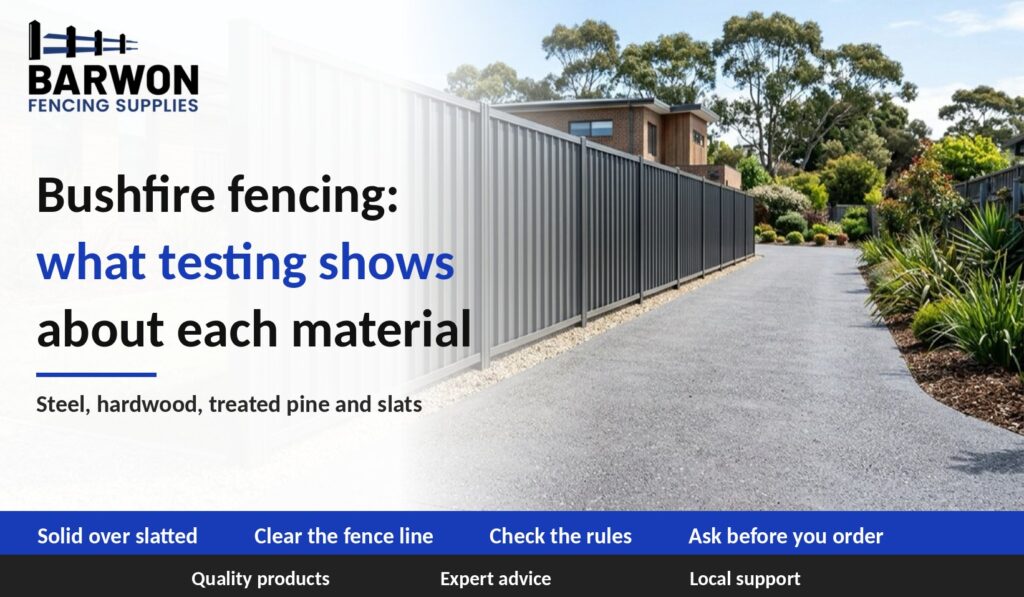
With warmer weather on the way, plenty of property owners around Greater Geelong are clearing gutters, cutting back long grass and looking at the fence line with fresh eyes. Fencing does not usually make the bushfire checklist, yet it sits between your home and whatever is coming across the paddock, the reserve or the neighbour’s yard.
No fence makes a property safe in a bushfire. What the research does show is that the material, the design and what you keep near a fence all change how it behaves. If you are replacing a boundary this summer, or live near grassland, bush or the Surf Coast hinterland, those differences are worth understanding before you order.
What the testing found
Much of the useful evidence comes from Bushfire CRC research, sponsored by BlueScope Steel, the maker of Colorbond steel. Researchers ran 23 experiments on 1.3 km of fencing, exposing it to embers, flame, radiant heat and burning leaf litter. The headline finding was that solid steel or hardwood fences gave better protection than treated pine or open slatted fences.
The details are more useful than the headline, because no material came through untouched. Here is how the main options performed:
| Fence type | What the experiments showed |
|---|---|
| Solid steel | Stayed standing through every experiment, although panels and posts buckled and separated at the joints and the surface coating scorched |
| Solid hardwood | Effective at stopping fire and radiant heat, but only with nothing combustible nearby. Palings began burning through in five and a half minutes under direct flame |
| Treated pine | Ignited and burnt to completion in all experiments, including the one started by leaf litter at the base |
| Open slats | Left houses exposed to embers and radiant heat, and offered little resistance to flame |
CSIRO’s bushfire guidance points the same way. It suggests solid, non-combustible materials such as brick, stone, concrete or galvanised iron where possible, and it warns against porous designs such as chain link and gapped pickets.
Why solid and non-combustible matter
CSIRO describes four ways a bushfire attacks a property: embers, heat, flame and wind. A solid, non-combustible barrier can work against all four by screening the house and garden. Gaps let embers and heat through, and a fence that burns can become a fuel source of its own, carrying fire along the boundary and towards buildings.
That is why Colorbond steel panels are often the first option people look at in exposed locations. They are non-combustible and form a continuous barrier, although the buckling seen in testing means a fence may still need replacing after a fire.
Non-combustible garden walls can also play a part. A low retaining wall built with concrete retaining sleepers does not add fuel in the way timber sleepers can, and it can pair with steel fencing above. Any retaining wall needs its own design check, so get advice suited to your site.
If you prefer timber, or already have it
Timber remains a practical and popular fence in plenty of settings, and many properties in established suburbs face a very different risk from those on the urban edge. Where bushfire is a real concern, the research suggests a few sensible adjustments:
- Keep timber fencing away from windows, doors, decks and eaves where you can, as CSIRO recommends
- Consider steel for the section closest to the house and timber further away
- Choose a solid fence over gapped palings or slats in exposed areas
- Ask about a suitable fire retardant treatment, as CSIRO advises for timber fences
If an existing fence is near the end of its life, our guide to working out what is failing in a timber fence can help you decide whether to repair it or plan for a replacement.
Clear the fence line before the season
This is the step that costs nothing but time, and it applies whatever your fence is made from. Treated pine in the testing ignited from leaf litter, and leaf litter builds up readily at the base of fences. CSIRO advises keeping fences clear of overhanging trees and shrubs, vines and creeping plants, and not storing garden waste or combustible mulch against them.
Work along the line and move anything that could burn. Common culprits include:
- Woodpiles, stacked offcuts and old pallets
- Bark mulch and garden waste piled against the fence
- Sheds, play equipment or parked vehicles close to a hardwood fence
- Climbers trained along the top rail
Surf Coast Shire’s bushfire landscaping guide recommends regularly removing leaf litter and reviewing your landscaping every year. It also notes that combustible boundary fences and screens raise the risk for you and your neighbours, which makes a shared boundary a good conversation to have together.
Check the rules before you order
The usual height limits still apply when you are fencing with bushfire in mind. The City of Greater Geelong says most side and rear fences can reach 2 metres without a building permit, while a fence within 3 metres of the street is limited to 1.5 metres. Anything secured to the fence that adds height counts towards the total. Planning controls, including overlays, can add further requirements, so check with your council if your property sits under one.
Newer subdivisions can also be restricted on materials and colours. Our guide to the three sets of rules in a new estate explains where to look before you commit to a product.
Frequently asked questions
Will a steel fence stop a bushfire reaching my home?
No fence can promise that. Solid steel performed well in testing, but it is only one part of preparing a property. Follow CFA and council guidance on planning and on managing the space around your home.
Is hardwood a better choice than treated pine in bushfire areas?
In the Bushfire CRC experiments, solid hardwood outperformed treated pine, which burnt completely each time. Hardwood still burnt through under sustained flame, so it needs a clear area around it to do its job.
Can I add height to my fence for extra protection?
Possibly, but extensions count towards the fence height. In Greater Geelong, a side or rear fence above 2 metres needs a building permit, so check before adding anything to the top.
Do I have to replace my timber fence if I live near bushland?
Not because of this research alone. Start by clearing combustible material from around it, then think about replacing the most exposed sections when the fence is due. Your council can confirm whether any planning controls apply to your land.
Does a slatted fence give any protection?
Very little. Testing found that open slats leave a home exposed to wind-blown embers and radiant heat. CSIRO also advises against gapped and chain link styles where the fence is meant to act as a barrier.
Thinking about the fence line before summer?
Bring your measurements and a note on what sits beyond the boundary, and the Barwon Fencing Supplies team can talk you through the steel, timber and sleeper options that suit your block. Get in touch and we can help you put the order together before the hot weather arrives.