
Fencing In A New Estate: The Three Sets Of Rules
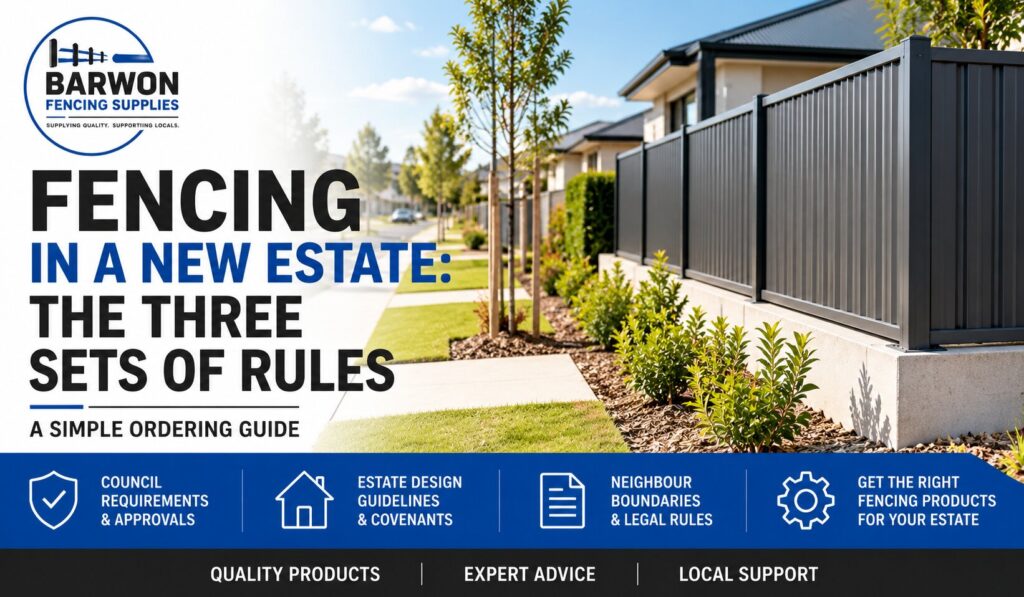
Buy a block in one of the growth corridors, and you inherit three separate sets of fencing rules at once. They come from different places; they do not always agree, and the strictest one wins.
Most people discover the third set after the fence is up. Here is what applies and how to check it before you order anything.
Layer one: the Building Regulations
State siting provisions under the Building Regulations 2018 set the baseline heights, and they are more specific than most people realise.
| Situation | Height limit |
| Front fence within 3m of the front boundary | 1.5m |
| Front fence where the block abuts a declared or arterial road | 2m |
| Fence within 9m of a corner intersection | 1m |
| Side and rear boundary fences | Generally 2m |
The corner rule catches people constantly. On a corner block, the fence must drop to a metre within nine metres of the intersection, which is there to keep sightlines clear for drivers. It applies to front gates and returns as well, not just the fence itself.
There is also a solar access provision. Where a neighbouring property has a north-facing habitable room window within three metres of the shared boundary, a fence over two metres may need modifying to protect light to that window.
Exceeding any of these is not automatically refused. It requires a report and consent from council, which is a formal application rather than a phone call.
Layer two: the planning scheme
On top of the state rules, the local planning scheme can tighten things further through zone schedules and overlays. Heritage, neighbourhood character and significant landscape overlays all commonly affect front fencing, and some zones set their own height limits.
Overlays are less common on greenfield estate land than in established suburbs, but they do appear, particularly near waterways and areas of environmental significance.
Layer three: what is on your title
This is the one that surprises people, and it is the one with the sharpest teeth.
New estates almost always carry restrictive covenants, a section 173 agreement, or a memorandum of common provisions registered against the title. These are legally binding on you and on everyone who buys the property after you. They are not developer suggestions.
They commonly control far more than height. Typical provisions include a prohibition on front fencing entirely to keep streetscapes open, a required material or a specific Colorbond fence colour palette, limits on how far a side fence can return toward the street, rules about whether timber palings are permitted at all, and a deadline for completing fencing after occupancy.
All of it sits on the Certificate of Title, and a current title search will list any covenant or agreement affecting the land.
The timing trap
Estate fencing runs on a sequence that rarely suits everyone. Across the new estates at Mount Duneed and the surrounding corridors, some developers install boundary fencing as part of the land sale, some contribute to it, and some leave it entirely to owners.
Where it falls to owners, the neighbouring block is often still vacant or still owned by the developer. Cost sharing for a dividing fence is governed by the Fences Act regardless, but pursuing a contribution from a party who has not built yet is slower and more awkward than dealing with a neighbour who has moved in.
Many covenants also set a period after occupancy within which fencing must be completed, so waiting indefinitely is not always an option either.
Pools sit outside all of this
If a pool or spa is going in, its barrier is regulated separately and far more tightly than any boundary fence. Any pool or spa capable of holding more than 300mm of water needs a compliant permanent safety barrier, and a building permit is required for the barrier regardless of height.
A boundary fence can form part of a pool barrier, but only if it meets the barrier requirements, which cover height, gaps, climbable features on both sides and a self-closing and self-latching mechanism. Registration and periodic compliance checks apply as well.
The practical point when planning an estate build is that a fence which satisfies your covenant and the siting rules may still be unusable as a pool barrier. Work the pool into the fencing plan early rather than retrofitting.
How to check before you order
- Get a current copy of your Certificate of Title and read the covenants and any section 173 agreement.
- Ask the developer or your conveyancer for the estate design guidelines, which are usually a separate document from the title.
- Check with the City of Greater Geelong whether an overlay applies and whether a report and consent is needed for what you want.
- Confirm whether boundary fencing is included in your land contract before assuming you are paying for it.
- If the block is a corner, measure nine metres from the intersection and plan the height step before you set out posts.
When the rules conflict
Where two sets of rules differ, comply with the strictest. A covenant permitting a 1.8 metre front fence does not override the state height limit, and the state limit does not entitle you to ignore a covenant that prohibits front fencing altogether. Approval under one does not imply approval under the others.
FAQs
Can a developer really dictate my fence colour?
If the requirement is registered on the title as a covenant or section 173 agreement, yes. It is a legally enforceable restriction on the land rather than a marketing preference, and it binds future owners as well. Design guidelines that are not registered on title sit in a weaker position, but they are often referenced by a registered agreement, which gives them force indirectly. Read what is actually on the title rather than relying on what the sales office said.
What happens if my fence breaches a covenant?
Covenants are enforced through the courts rather than by council, usually by the developer or by another owner in the estate who benefits from the restriction. Outcomes can include an order to modify or remove the fence. The practical risk is often delayed, surfacing at sale when a purchaser’s conveyancer identifies the breach and asks for it to be resolved before settlement.
Can I have a front fence at all in a new estate?
Often not, or not a solid one. Open frontages are a common design objective in newer estates, and many covenants either prohibit front fencing or limit it to a low, largely transparent treatment. Where something is permitted, it will usually be well below the state height limit. This is the single most common surprise for buyers coming from an established suburb.
Does the developer install the side and rear fences?
It varies by estate and sometimes by stage within the same estate. Some land contracts include boundary fencing, some include a contribution, and some include nothing. It is worth confirming in writing rather than assuming, because the difference is significant and it is easy to end up paying twice.
Why does my corner fence have to step down?
Sightlines. Within nine metres of an intersection of street boundaries, fence height is limited to a metre so drivers can see pedestrians, cyclists and children near the corner. It applies to the fence, any gate and any planting that would have the same effect. Stepping the fence rather than raking it usually gives the tidiest result.
Everything You Need for a Stronger Fence
The cheapest way to avoid a fencing problem in a new estate is a ten-minute conversation before the order goes in, not after the posts are concreted.
Bring your title search and your estate design guidelines, and we can check the materials, colours and heights you are allowed against what you are planning. We supply fencing across the Geelong growth corridors and see the same estate requirements regularly, so the spec sheet usually looks familiar.
Call 0413 501 232, email sales@barwonfencingsupplies.com.au, or come into 92 O’Brien’s Road, Corio VIC 3214. Full range at barwonfencingsupplies.com.au.