
Pool Barrier Rules: Why Your Pool’s Age Decides Them
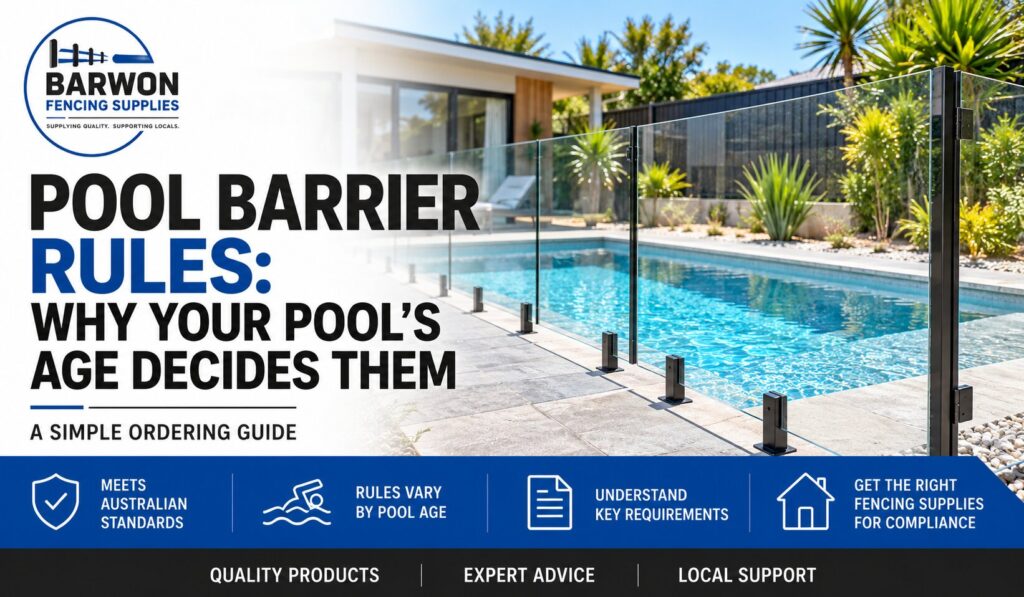
Pool barriers are the one area of fencing where the rules are not negotiable, and the consequences of getting them wrong are not financial. Drowning remains a leading cause of preventable death among young children, and a compliant barrier is the thing standing between a toddler and the water.
Victorian requirements are also more specific than most owners realise, and one detail in particular catches nearly everyone.
Registration and the four-year cycle
Any pool or spa on a residential property capable of holding water more than 300mm deep must be registered with your council and surrounded by a compliant barrier. That includes spas and portable above ground pools, not just in-ground pools.
Barriers must be inspected by a registered pool safety inspector or building surveyor, who issues a Form 23 Certificate of Barrier Compliance. That certificate is lodged with council, and the cycle repeats every four years, running from the last inspection or from the certificate of final inspection for the most recent construction or alteration.
A current Form 23 is also required when selling a property with a pool, which is where a lapsed certificate usually becomes urgent.
Your pool’s age decides which rules apply
Here is the detail that surprises people. There is no single pool barrier standard in Victoria. Your barrier is assessed against the edition of AS 1926.1 that was in force when the pool was built, or when the barrier was last altered, not the current edition.
The core figures hold across every edition. Minimum barrier height of 1200mm, gaps no wider than 100mm between vertical members, and no more than 100mm between the bottom of the barrier and the ground.
What changes between editions is the non-climbable zone, and it changes significantly. Under the 1993 edition, the clear arc is 1200mm. Under the 2007 and 2012 editions, it tightens to 900mm. A barrier built under the older edition is held to the older, wider zone.
This matters when planning work. Altering a barrier can bring it under the current edition, which occasionally means a small repair triggers a larger upgrade. Worth knowing before you start rather than after.
The non-climbable zone, properly explained
This is the requirement most often misunderstood, because people think about gaps and forget about footholds.
The non-climbable zone is a clear arc measured from the top of the barrier, extending outward and downward on the side away from the water. Nothing within it can offer a child a foothold or handhold. A separate, smaller clear zone applies on the pool side.
The zone is not only about objects you can move. A horizontal rail on the outside face sitting inside the arc is a failure in itself, even where every gap measures perfectly, which is why some older tubular fencing cannot be made compliant without modification. Raised garden beds, retaining walls, air conditioning units, pool pumps and decking around the pool all count if they sit inside the zone and give a child something to stand on.
What fails inspections
The same handful of problems account for most failures, and nearly all are fixable.
- Gates that do not self-close and self-latch from every position, including when released from just ajar.
- Pot plants, chairs, eskies, toys or bins left inside the non-climbable zone.
- Gaps under the barrier opening up as ground settles or mulch is moved.
- Latches mounted too low or reachable through the barrier.
Worn gate hardware is the single most common defect. Hinges and latches carry constant load, live outdoors and are frequently the cheapest components on the whole barrier. Gates must open away from the pool, and the hardware has to work reliably every time rather than most of the time.
Using a boundary fence as part of the barrier
Victoria does allow a boundary fence to form part of a pool barrier, and specific provisions apply to boundary barriers. The condition is that the fence must satisfy every barrier requirement in its own right, including the non-climbable zone on the neighbour’s side, which you do not control.
That last point is the practical catch. A neighbour’s shed, woodpile or garden bed against the far side of the fence can make your barrier non-compliant without anything changing on your property. Solid Colorbond panels avoid the gap and foothold issues that come with rails, while a timber boundary fence needs checking for horizontal rails, gaps opening between palings and the height once ground levels differ across the boundary.
Where it is workable, a separate barrier inside the boundary removes the dependence on what happens next door.
What materials are allowed
The standard sets performance requirements rather than naming approved products, so glass, aluminium, steel, mesh and timber can all work provided the finished barrier complies.
Where they differ is how easily they get there. Vertical members need spacing under 100mm. Anything with horizontal elements needs those elements kept clear of the non-climbable zone, which rules out a lot of otherwise attractive designs. Solid panels sidestep the gap question entirely but must be checked for climbable framing and for the height achieved once ground levels vary along the run.
Barriers must also be permanent, meaning they cannot be removed without tools, and every component has to stay in working order for the life of the pool rather than just on inspection day.
Before you fill the pool
A pool or spa must not be filled until the barrier is complete and approved. It is a sequencing requirement people run into when a build finishes and the water is the exciting part, but the order is not optional.
FAQs
Does an inflatable or portable pool need a barrier?
If it can hold water more than 300mm deep, yes, and it also needs registering. Temporary and inflatable pools are a recognised risk precisely because families treat them as outside the rules. The safest approach with a portable pool is to empty and store it when not in use, since a filled pool without a compliant barrier is both unlawful and genuinely dangerous.
Can a door from the house open into the pool area?
Requirements for doors and windows forming part of a barrier vary by the edition applying to your pool, and newer editions are considerably stricter about direct access from a dwelling. Because this is one of the areas where the editions differ most, it is worth confirming with an inspector rather than reasoning from something you read about another state.
My pool was built decades ago. Am I exempt from modern rules?
No. Older pools are assessed against the edition in force when they were built, which is different from being exempt. The barrier still has to comply with that edition, still needs registration, and still needs a Form 23 every four years. Older barriers frequently fail on climbable elements that were acceptable in their day but not under the edition actually applying to them.
What if my neighbour puts something against the shared fence?
If that fence forms part of your pool barrier and the object creates a foothold in the non-climbable zone, your barrier is non-compliant, and the obligation sits with you as the pool owner. A conversation usually resolves it. Where it keeps recurring, building a separate barrier inside your own boundary is the reliable fix.
Can I do the work myself?
You can carry out maintenance such as adjusting a latch or clearing the non-climbable zone. Constructing or altering a barrier requires a building permit, and compliance must be certified by a registered inspector regardless of who does the work. Given what the barrier is for, this is not an area to improvise.
Quality Fencing Materials Start Here
The most useful thing to establish before buying any pool fencing material is which edition of the standard your pool falls under. It changes the clearances, and material that suits one edition may not satisfy another.
Tell us the age of your pool, whether the barrier is being repaired or replaced, and whether a boundary fence is doing part of the job. Our team can talk through materials and hardware that suit the requirement. For certification itself, you will need a registered pool safety inspector, and we would always recommend confirming your position with one before committing to a design.
Call 0413 501 232, email sales@barwonfencingsupplies.com.au, or visit 92 O’Brien’s Road, Corio VIC 3214. Full range at barwonfencingsupplies.com.au.