
Driveway Gates: Let The Site Decide, Not The Catalogue
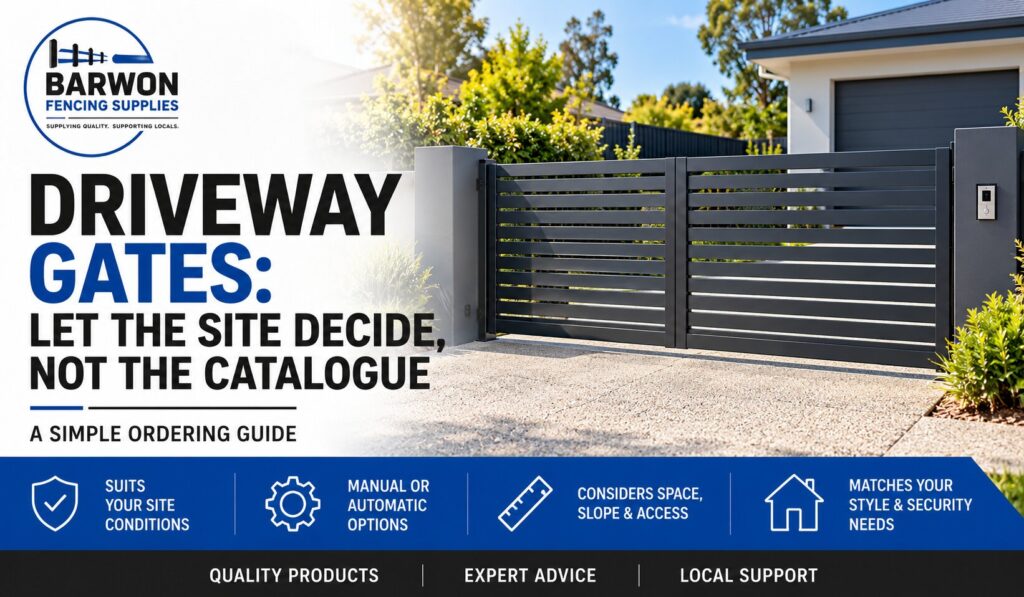
Most people start choosing a driveway gate by looking at pictures. It is the wrong end of the process. The site dictates what will actually work, and a design that ignores the ground, the slope and the space on either side ends up being modified, replaced or left permanently propped open.
Work through the constraints first, and the style choice becomes easy.
Start at the road
Before anything else, look at where a car waits while the gate opens. If the vehicle has to stop on the road or across the footpath, the gate is set too close to the boundary. Allowing enough depth for a car to pull clear of traffic is the difference between a gate you use and a gate you stop using.
Sightlines matter too. On a corner block, fence height is restricted to a metre within nine metres of the intersection, and that restriction applies to gates as much as to fencing. Check the corner geometry before settling on a position.
A gate should also never swing out over a footpath or road reserve. Any part of the movement crossing public land is a safety and planning problem rather than something to manage with care.
Width: measure the movement, not the gap
There is no standard driveway gate width in Australia, which is why gates made to measure are so common. The right opening depends on your driveway, the angle vehicles approach at, and what you need to get through.
The most common mistake is measuring the driveway and ordering that width. A car entering straight on needs far less room than one turning in off the street, and a tight approach angle can make a generous-looking opening feel impossible. Size for the movement, not the gap.
The second mistake is sizing for the cars you own today. Trailers, boats, caravans, a removalist truck or a concrete pump all have to get in at some point, and widening an opening later means new posts and usually a new gate.
Swing or slide: the site decides
This is usually settled by the ground rather than by preference.
| Opening width | Usual answer |
| Up to about 3m | Single swing, double swing, or sliding |
| 3m to 5m | Double swing if there is room to swing, otherwise sliding |
| Over 5m | Sliding is generally cleaner |
Swing gates need clear, reasonably level ground through the whole arc. A driveway that rises from the road is the classic problem, because the gate fouls the ground as it opens. Sliding gates are indifferent to slope across the opening but need run-back space along the fence line roughly equal to the gate width, plus extra for the motor and overlap.
On rural properties around Lara, there is usually room for either. On a tight suburban block, whichever one fits is the one you are having. A bi-parting sliding gate is worth knowing about where a single slide will not fit, since each leaf needs a little over half the opening.
Ground fall and levels
Very few driveways are dead level. Fall across the opening changes the gap under the gate at each end, and fall along the run affects a sliding gate track.
Options include raking the bottom of the gate to follow the ground, stepping it, or building up the level so the gate can sit square. Each has a different look, and the decision should be made before fabrication rather than solved on site with a grinder.
Posts are the part that fails
A gate post does a completely different job from a fence post. It carries the dead weight of the leaf hanging off one side, plus the cyclic load of every open and close, plus wind load on a solid panel.
That means a heavier post section, a deeper and wider footing, and proper curing before the gate is hung. Sag shows up first as a gap along the closing edge that will not line up, and by then the fix is usually excavation rather than adjustment.
If automation is likely, the post requirements go up again, because a motor drives the gate against whatever resistance exists rather than stopping like a person would.
Wire for automation now
Even if a motor is years away, running conduit while the driveway is open costs very little. Retrofitting power across a finished concrete driveway is disruptive and expensive.
Powered gates carry real safety obligations. They need obstruction detection and protection at crush and entrapment points, and any electrical work must be carried out by a licensed electrician. Larger gates may also trigger permit requirements, so check before committing to a design.
Hardware and finish
Hinges, latches and drop bolts do the work and are usually the first things to fail. Specify them for the weight of the leaf and the exposure of the site rather than taking whatever comes in the box. A matching Colorbond infill keeps a gate reading as part of the fence rather than an addition, and powder coating gives a durable finish over a properly prepared substrate.
FAQs
Can a new gate be built to fit my existing posts?
Often yes, and it is a sensible way to refresh an entrance without redoing the fence. The posts need assessing first for section size, footing depth and plumb, since a post that was adequate for an old light gate may not suit a heavier replacement. Measure the actual opening between posts rather than the driveway width, and check whether the posts sit square to each other, because a fabricated gate assumes they do.
Is a separate pedestrian gate worth including?
Almost always. Opening a full driveway gate to put the bins out, take a delivery or walk the dog gets old quickly, and on an automated gate it adds unnecessary cycles to the motor. A pedestrian gate alongside also gives you a way in when the power is out or the motor is being serviced.
Can my gate open outwards?
Only if the entire swing stays within your property. If any part of the movement crosses the footpath or road reserve, it is not an option, regardless of how quiet the street is. Where an inward swing will not work because of slope or space, sliding, bi-parting or folding arrangements are the alternatives to look at.
Should a steel gate be powder coated?
Powder coating gives an even, durable finish and a wide colour range, and it performs well provided the substrate is prepared correctly. Galvanised steel needs the coater to know in advance, since surface condition affects adhesion. Specify the finish at order stage, because coating a gate after fabrication is straightforward while recoating one already installed is not.
What maintenance does a steel gate need?
Very little, but not none. Check and lubricate hinges and latches periodically, keep the track and rollers clear on a sliding gate, wash down coastal or dusty sites, and touch up any coating damage promptly. Most gate problems start as a small alignment or hardware issue that was easy to fix and got left.
Make Your Next Fencing Project Easier
Here is the most useful thing you can bring us. Stand where a car would wait to come in, and take a photo looking at the entrance. That single image shows the approach angle, the fall of the ground, the space on either side and how close the opening sits to the road, which, between them, decides most of the design.
Add the opening width, what vehicles need to get through and whether automation is likely later, and our team can talk through what will work. Have a look at gates and fences we have supplied for a sense of what suits different entrances.
Call 0413 501 232, email sales@barwonfencingsupplies.com.au, or come into 92 O’Brien’s Road, Corio VIC 3214. Full range at barwonfencingsupplies.com.au.