
Coastal Fencing: Salt, Wind And What Fails First
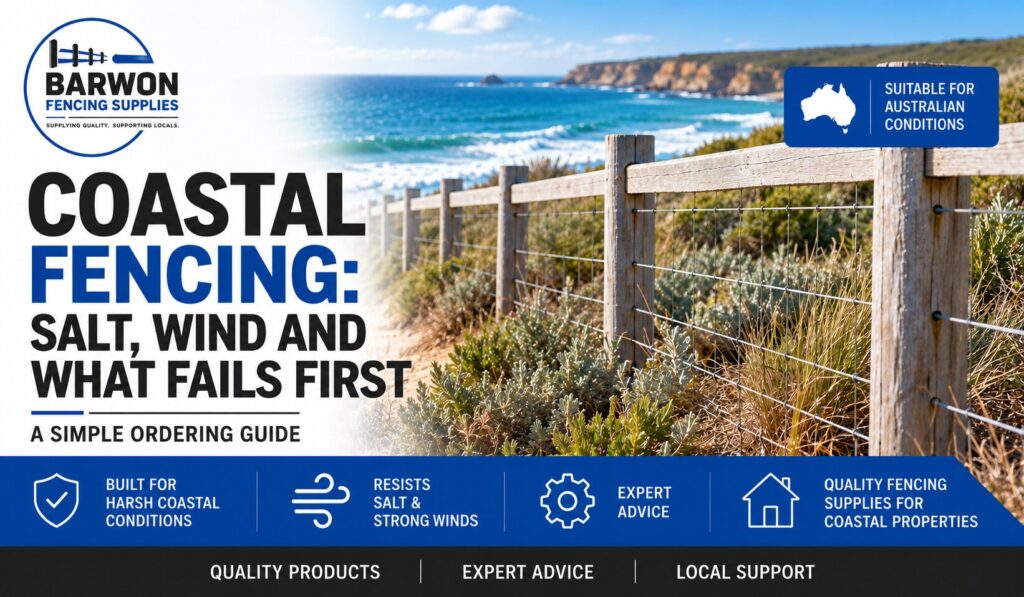
Everyone near the water knows salt is hard on a fence. What surprises people is where the damage starts. It is almost never the middle of a panel. It is the screws, the brackets, the hinges and the base of the posts, and those parts usually go years before anything else looks wrong.
Getting a coastal fence right is mostly about specifying the small components properly. Here is how exposure works around Geelong, and what to do about it.
There is no single coastline here
Exposure is graded by how much airborne salt reaches a site, and the region spans three quite different situations.
The ocean side of the Bellarine, around Ocean Grove, Barwon Heads and Point Lonsdale, sits in breaking surf conditions. Surf generates fine salt aerosol that travels a long way inland on a sea breeze, and it is the most aggressive environment of the three.
The bay side is calmer. Portarlington, St Leonards and Indented Head face sheltered water that produces far less aerosol, as do the Corio Bay suburbs. Salt is still present, but the exposure category is lower.
Then there is everywhere else. A few kilometres inland at Waurn Ponds or Grovedale, salt stops being the governing factor and normal material choices apply. Distances are measured from the high water mark, and the drop-off is steep, so two streets can genuinely need different specifications.
What salt actually does
Salt aerosol lands on a surface and stays there. Chloride is hygroscopic, meaning it draws moisture from the air, so a salted surface stays damp long after rain has dried off elsewhere. That constant film of salty moisture is what drives corrosion.
Two consequences follow. Sheltered surfaces corrode faster than exposed ones, because rain never washes the salt off. And any place where two components meet and hold moisture, such as a bracket against a post or a screw head in a dimple, becomes the first point of failure.
The stainless steel mistake
Common advice for coastal building is to use marine-grade 316 stainless fasteners. For timber, that is correct. Grade 304 pits within months in a coastal atmosphere, and 316 contains molybdenum that resists chloride attack far better.
For prepainted steel fencing, the same advice causes problems. Sheet manufacturers specify fasteners to AS 3566 Class 3 or better, and recommend stainless fasteners only with stainless cladding. Stainless in contact with coated steel in a salty, damp environment sets up galvanic corrosion, and the coated sheet gives way around the fastener rather than the fastener failing.
For severe coastal exposure, the right answer is a Class 4 fastener, which is designed for marine and industrial atmospheres, rather than reaching for stainless because it sounds tougher. Matching the fastener to the material it goes into matters more than picking the most corrosion-resistant metal on the shelf.
Wind is the other half of the problem
Coastal blocks are usually exposed blocks, and a solid fence catches close to the full wind load. That pushes footing requirements up, not just material grade.
Expect deeper and wider footings than an equivalent fence in a sheltered street, and pay particular attention to gate posts, corners and the ends of long runs. Sandy coastal soil compounds this, since it has poor bearing and lets a shallow footing work loose. Flaring the base of the hole wider than the top helps considerably.
Where a solid barrier is not essential, a fence with some permeability will take far less load and last longer in an exposed position.
Material notes
Prepainted steel performs well across most of suburban Geelong, and closer to salt water, a higher specification grade is what preserves the warranty. Confirm the current terms for fencing specifically, since published warranty bands often relate to roofing rather than fences. For hardwood and treated timber, salt itself is not the enemy. Durable hardwood species and correctly rated treatment handle coastal air well, and the failure mode remains moisture at the base of posts.
Concrete sleepers are essentially indifferent to salt air, which makes them a sound choice for coastal retaining. For decks in the same conditions, composite decking avoids the constant oiling cycle that salt and UV together demand from timber, though the substructure and fixings still need specifying for the environment.
Hardware is where money is saved badly
Panels and posts get specified carefully, then the hinges, latches, brackets and screws get picked from whatever is closest to hand. In a coastal setting, that is backwards, because those components have the highest surface area to volume ratio, sit in the wettest spots, and carry moving loads.
Gate hardware deserves the most attention of all. A hinge that binds because of corrosion puts extra load into the post, and a latch that seizes usually gets forced, which damages the fitting and the gate together. Specify hardware for the exposure category, not for the price, and expect to rinse and lubricate it.
Maintenance that actually matters
One habit does more than any other. Hose down the fence a few times a year, concentrating on surfaces that rain never reaches, such as the underside of rails, the sheltered face of a fence beside a wall, and anywhere hardware sits.
- Wash sheltered areas, since exposed ones are largely self-cleaning.
- Keep soil, sand and mulch away from the base of posts and panels.
- Rinse salt off gate hardware and moving parts, then lubricate.
- Touch up scratches promptly, because a break in the coating is where coastal corrosion begins.
FAQs
How close to the water counts as coastal?
Closer than most people assume, and it depends on which water. Surf coast exposure carries much further inland than sheltered bay exposure, because breaking waves generate fine aerosol that the wind carries. As a working guide, treat anything within a few hundred metres of open surf as severe, anything within roughly a kilometre as coastal, and sheltered bay frontage as a category below ocean frontage at the same distance. Prevailing wind direction matters too. A block downwind of the water is more exposed than one shielded by a rise or by established housing.
There are rust streaks running down from the screws. What went wrong?
That pattern almost always means the fasteners were underspecified for the environment, or the wrong fastener type was paired with the sheet material. The streaking is corrosion product washing down the panel, which is cosmetic in itself, but it signals that the fixings are deteriorating. Replacing them with correctly specified fasteners is usually straightforward and far cheaper than waiting until the fixing points fail.
Does fence colour make any difference near the coast?
It makes some. Darker colours run hotter in the sun, and heat combined with salt accelerates coating degradation slightly. Lighter colours also show salt deposits less between washes. The effect is modest compared with getting the material grade and fixings right, so choose the colour you want and put the effort into specification instead.
Will a concrete sleeper wall hold up near the beach?
The concrete handles salt air well. The parts worth attention are the steel posts and any exposed fixings, which need coating appropriate to the exposure category, and drainage, since salty groundwater sitting against steel is more aggressive than fresh. Specify the coating up rather than down when the wall is near the water, because once the wall is backfilled, the buried steel cannot be inspected or maintained.
Is it worth using coastal grade materials a few kilometres inland?
Generally no. Beyond the coastal zone, the additional specification buys very little, and the money is better spent on footings, post quality or a taller fence. The exception is a site that is inland but unusually exposed, such as an elevated block with a clear line to the water and strong prevailing wind, where salt carries further than distance alone suggests.
Make Your Next Fencing Project Easier
The fastest way to get a coastal fence specified correctly is to tell us where it is going. The street, roughly how far the water is, and which way the weather comes from tell us more than any general rule, and the answer genuinely changes between the ocean side of the Bellarine and the bay.
Barwon Fencing Supplies can match materials, coatings and fixings to your exposure rather than leaving the small components to chance. Those fittings are the parts most often left off an order and the parts most likely to fail first. See the areas we supply across the region.
Call 0413 501 232, email sales@barwonfencingsupplies.com.au, or visit 92 O’Brien’s Road, Corio VIC 3214. Full range at barwonfencingsupplies.com.au.