
Composite Or Timber Decking: What Changes At Each Stage
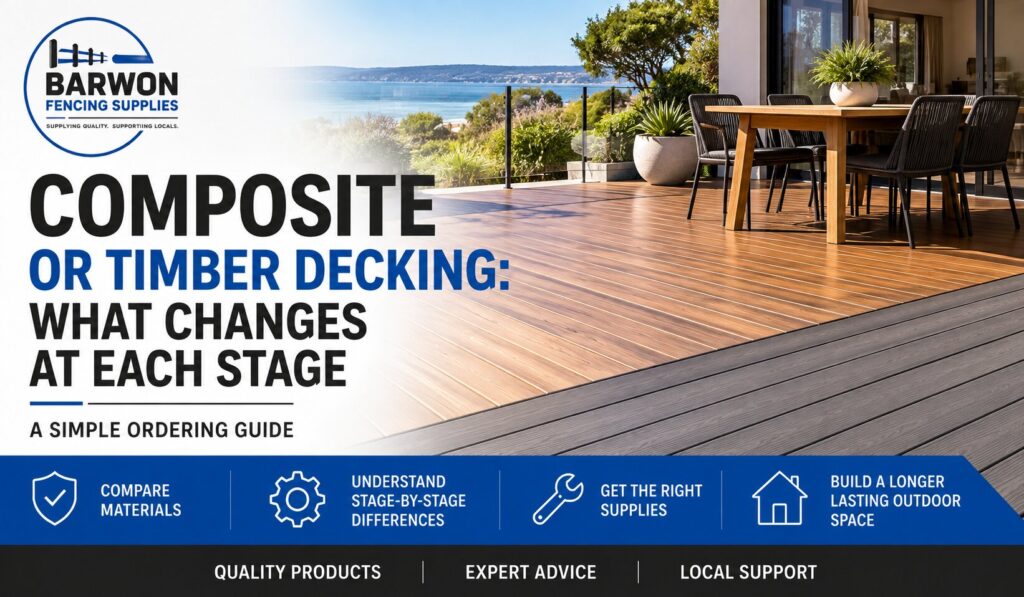
Most comparisons of composite and timber decking argue about which is better overall, which is not a question with an answer. The difference shows up at particular moments: when you apply for approval, when the frame goes down, when you first walk on it barefoot in February, and when it has been there ten years.
Working through it stage by stage is far more useful than a list of pros and cons.
What you are actually buying
Composite boards are a mix of wood flour and polymer. The distinction that matters most within a composite decking range is whether boards are capped or uncapped. Capped boards carry a bonded polymer shell that resists staining, fading and moisture far better than the older uncapped product that gave composite a mixed reputation a decade ago.
The second distinction is solid versus hollow core. Solid boards feel more like timber underfoot and handle load better. Hollow boards are lighter and cheaper, and they sound different when you walk on them, which some people notice immediately, and others never register.
Timber decking is graded by species and durability class. Hardwoods such as merbau and spotted gum sit at the durable end, while treated pine needs the correct treatment rating for its exposure.
Before you build: the approval nobody expects
This catches people out regularly in Victoria, and it applies whichever material you choose.
A freestanding deck can avoid a building permit only if it stays at or under 10 square metres and no more than 800mm above natural ground level. Ten square metres is roughly three metres by three point three, which is smaller than most entertaining decks.
The part that surprises people is attachment. A deck fixed to the house has no size or height exemption at all. A small landing bolted to a wall still requires a building permit. Once a deck sits more than a metre above ground, a compliant balustrade comes into it as well.
On a sloping block, the measurement can vary across the deck, putting one end above the threshold and the other below. Check with the City of Greater Geelong or a registered building surveyor before ordering anything.
At framing: the frame decides the boards
Composite is a surface, not a structure. The frame beneath it is still timber or steel, still needs correct footings, and is still the part that will fail first if it is built poorly. Choosing composite changes nothing about the outdoor building products that go into the substructure.
What it does change is joist spacing. Composite boards generally need closer joist centres than timber, and closer again where boards run diagonally or on stairs. This is the single most expensive thing to get wrong, because spacing is fixed once the frame is down. Deciding on boards after the frame is built is how people end up either adding joists or changing their board choice.
Confirm the required spacing for the specific board before the frame is set out, not after.
At installation: leave room to move
Composite expands and contracts with temperature more than timber does, and along its length rather than across its width. Boards need end gaps, and the size of those gaps depends on board length and the temperature on the day of installation.
Boards installed on a cold morning will expand considerably by January. Butting them tight because the gap looked untidy is the most common installation error, and the result is buckling that cannot be fixed without lifting boards.
Timber behaves the opposite way, shrinking across its width as it dries, which is why timber decks develop wider gaps between boards over the first year rather than buckling.
Living with it
Composite runs hotter than timber in direct sun, and dark colours run hottest. On a west facing deck with no shade, which describes plenty of newer homes around Waurn Ponds, that matters more than any other factor on this page. Lighter colours help, and so does shade over part of the deck.
Low maintenance is no maintenance. Composite needs washing, and shaded damp areas will grow surface mould on composite just as they do on timber. The difference is that cleaning is the whole job, with no sanding, oiling or staining cycle to keep up.
Timber asks for oiling every year or two depending on exposure. Merbau also leaches tannin when new, which stains adjacent concrete and rendered walls unless boards are pre-sealed.
Ten years in
Capped composite holds colour well and generally lightens slightly in the first months before stabilising. It cannot be sanded back, so scratches and any damage are permanent unless a board is replaced. Keeping spare boards from the original batch is worth doing, since colours shift between production runs.
Timber weathers continuously. Left alone it silvers, and it can be sanded and refinished to look new again, which composite cannot. Whether that is an advantage depends entirely on whether you intend to do it.
Choosing between them
- Pool surrounds and wet areas: composite, for the lack of splinters and the absence of an oiling cycle.
- Full sun with no shade: timber, or a light coloured composite.
- Period homes and character properties: timber.
- Rental or holiday properties: composite, since upkeep will not happen.
Looking at real examples helps more than brochures. Have a look at decks we have supplied to see how both materials sit in finished outdoor areas.
FAQs
Can I lay composite boards over my existing timber deck frame?
Sometimes, and it depends on two things. First, the frame has to be structurally sound, which means checking bearers, joists and footings rather than judging by the surface. Second, the existing joist spacing has to suit the composite board you want, and older timber decks are often framed at wider centres than composite requires. Where spacing is too wide, adding intermediate joists is usually possible. Reusing a frame that is already at the end of its life to save money at the surface is a false economy.
Does composite get too hot to walk on barefoot?
In full summer sun it can, particularly in darker colours. It is a real consideration rather than a marketing quibble, and it is the most common regret people report. If the deck gets strong afternoon sun with no shade, choose a lighter colour, plan for shade, or reconsider the material for that particular area.
Can composite decking be sanded or refinished?
No. The capped layer is what provides the performance, and sanding removes it, which makes the board worse rather than better. Deep scratches and gouges are permanent. This is the main practical trade-off against timber, which can be brought back repeatedly.
Will composite grow mould?
It can. Composite contains wood flour, and in permanently shaded, damp spots, surface mould will establish on the board just as it does on outdoor furniture or pavers. It sits on the surface rather than degrading the board, and washing removes it. Good airflow under the deck and keeping leaf litter off the surface both help considerably.
How long does composite decking last compared to timber?
Well-installed capped composite should comfortably outlast a timber deck surface of similar quality, and warranties reflect that. The qualifier worth remembering is that a deck is only as durable as its frame and footings. A composite surface on a poorly built substructure will not deliver its expected life, which is why spending on the parts nobody sees matters most.
Visit Barwon Fencing Supplies Today
The best time to talk about decking boards is before the frame goes down, not after. Joist spacing is set at the framing stage, and it is the one decision that locks in or rules out board options later.
Tell us the deck dimensions, which way it faces and how much sun it gets, and our team can talk through board types, colours and the spacing your chosen boards will need. We supply composite decking and the materials that go underneath it across Greater Geelong, for pickup or delivery.
Call 0413 501 232, email sales@barwonfencingsupplies.com.au, or come to 92 O’Briens Road, Corio VIC 3214. Full range at barwonfencingsupplies.com.au.