
Colorbond Or Timber Fencing For A Geelong Property
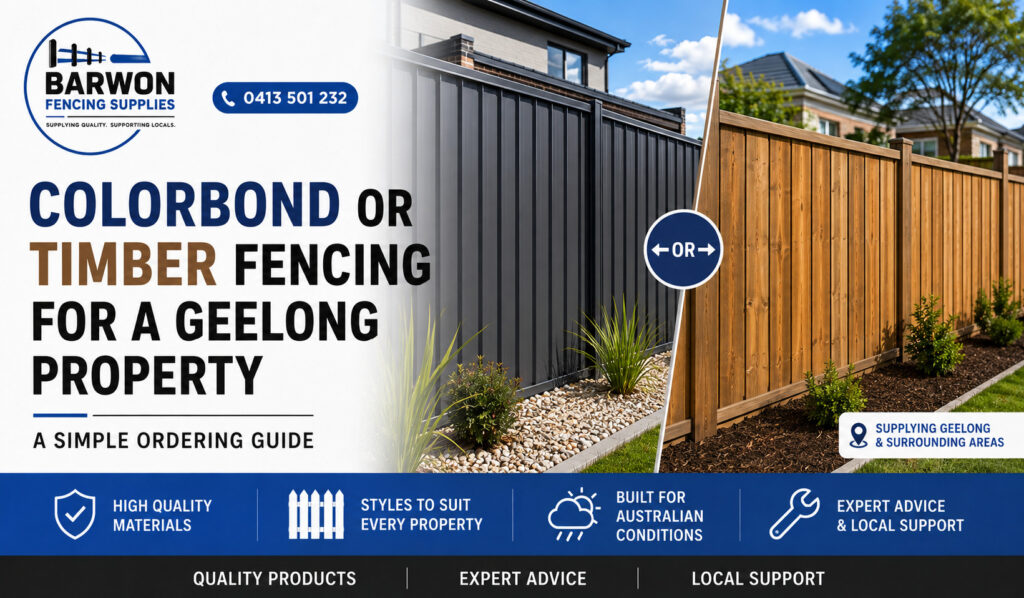
It is the question that stalls more fencing projects around Geelong than any other. Timber looks warm and costs less up front. Colorbond looks sharp and asks nothing of you for decades. Both are everywhere in the region, which suggests neither is simply better.
The honest answer is that the right choice depends on where your property sits, how much weekend maintenance you are realistically willing to do, and what the fence needs to survive. Here is how the two compare on the things that actually decide it.
The short version
| Factor | Colorbond steel | Timber |
| Typical service life | Several decades with minimal intervention | Around 10 to 20 years, shorter in wet ground |
| Maintenance | Occasional wash down | Regular oiling or staining, plus repairs |
| Appearance over time | Holds colour, fades slowly and evenly | Silvers and weathers unless treated |
| Privacy and noise | Solid panel, no gaps as it ages | Gaps open as boards shrink and cup |
| Repairability | Panel replacement, colour match needed | Individual palings easily swapped |
| Coastal exposure | Depends on product grade and distance to salt | Unaffected by salt, affected by damp |
| Termites | Not a food source | Requires treated or durable species |
Lifespan comes down to what fails first
A timber fence rarely fails as a whole. It fails at the posts, right at the soil line, where moisture and oxygen meet. Everything above can still look serviceable while the fence leans a little further each winter. Treated pine rated for in-ground contact under AS 1604 buys real years here, and posts rated only for above-ground use are the single most common reason a fence goes early.
A Colorbond steel fencing panel fails differently. The steel is protected by a metallic coating and a baked paint system, so degradation starts wherever that coating is broken or where salt sits undisturbed. Cut edges, scratches from a whipper snipper, and the base of posts sitting in damp soil are the places to watch. Left alone in a normal inland backyard, it simply keeps going.
Maintenance is the real dividing line
Timber asks for attention on a cycle. Oiling or staining every few years keeps the colour and slows moisture uptake, and skipping it does not destroy the fence but does change how it looks and how long it lasts. Boards cup, nails back out, and the odd paling needs replacing.
Colorbond asks for almost nothing. An occasional hose down where sheltered areas are not washed by rain, and keeping soil and mulch from banking up against the base. That is the whole list.
Worth being honest with yourself here. The lower up-front cost of timber assumes you will do the upkeep. If you know you will not, the maintenance gap closes the value gap faster than the price tag suggests.
The coastal question, which matters more here than most places
Greater Geelong is not one environment. BlueScope classifies sites by proximity to salt, and the categories fall roughly into benign inland, coastal, and severe coastal, with distances measured from the high water mark.
That matters because a property backing onto Corio Bay sits in a very different category from one on the streets around Highton a few kilometres inland. Calm marine influences like the bay have their own thresholds, separate from the breaking surf conditions found on the ocean side of the Bellarine. Standard product is fine across most of suburban Geelong. Closer to salt water, a higher specification grade is what protects the warranty.
Timber is indifferent to salt, which is a genuine advantage in exposed coastal spots. What it is not indifferent to is persistent damp and wind loading, so the trade-off shifts rather than disappears.
If your property is close to the water, confirm the correct product grade and current warranty terms for fencing specifically before ordering. Warranty bands differ between roofing, walling and fencing applications.
Cost behaves differently over time
Timber generally costs less to buy and install. Colorbond generally costs less to own.
The variables that move either number are the same ones every time: fence height, post spacing, whether the ground is level or stepped, how accessible the site is for delivery and digging, and whether old fencing has to be removed and disposed of. A sloping block in an established suburb will always cost more to fence than a flat new estate lot, whatever material you pick.
The useful comparison is not the quote on day one. It is the quote plus twenty years of upkeep, plus whether you will actually do that upkeep.
Where timber still wins
Character is not a small thing. On period homes through Newtown and Geelong West, timber fencing sits correctly with the architecture in a way steel does not, and a hardwood picket or a lapped and capped paling fence reads as part of the house rather than a boundary marker.
Timber also repairs gracefully. A damaged paling is a ten-minute job with a spare board, no colour matching and no panel to source. It can be painted or stained any colour you like, and changed later when you tire of it. For fences on curves, unusual angles or heavily stepped ground, timber adapts with less fuss.
Choosing by situation
- Low maintenance is the priority, standard suburban block: Colorbond.
- Period home where street appearance matters most: timber.
- Backing onto a road or wanting to cut traffic noise: Colorbond, solid panel and no gaps.
- Very close to the bay or open coast: check product grade carefully, and weigh a durable timber option.
- Rental or investment property: Colorbond, because upkeep will not get done.
Whichever way you go, decide on any matching gate at the same time rather than later. Matching a gate to an existing fence is always harder than building both together.
FAQs
Can I put Colorbond panels onto my existing timber posts?
Generally no, and it is not worth attempting. Colorbond fencing is a system where the posts, rails and sheets are designed to work together, with sheets sliding into channels rather than being fixed to a face. Timber posts are also usually the oldest and most degraded part of a fence, so building a new fence onto them starts the clock at zero. If the posts are sound and you want to keep them, a timber rebuild is the sensible path.
Does a Colorbond fence get hot enough to damage nearby plants?
A dark fence in full afternoon sun will radiate noticeable heat, which can stress tender plants growing hard against it. Lighter colours reflect more. The practical fix is a planting gap of a hand span or so for airflow, which also keeps foliage and mulch off the base of the sheets and helps the fence last longer. Avoid fixing trellis or climbers directly to the panels.
Which handles a sloping block better?
Both can be stepped or raked, but they behave differently. Colorbond steps cleanly in panel increments, which looks deliberate on a consistent slope and leaves triangular gaps at the base that can be infilled. Timber can be raked to follow the ground continuously, which suits uneven or gently undulating ground. On a steep or irregular fall, timber usually gives the tidier result.
Can I combine both materials in one fence?
Yes, and it is increasingly common. Colorbond along the side and rear boundaries where nobody sees it, with timber on the street frontage where appearance carries weight, is a sensible split. Some builds also use steel posts with timber infill for durability underground and warmth above it. Just settle the design before ordering, because the two systems use different post sizes and spacings.
Which one do buyers prefer when it comes time to sell?
Neither material reliably outperforms the other. What buyers actually respond to is a fence that is straight, complete and consistent around the property. A tired timber fence with mismatched replacement palings reads as deferred maintenance. A well-kept fence in either material simply looks resolved, and that is the part worth spending on.
Visit Barwon Fencing Supplies for Your Next Fencing Project
Colour swatches on a screen are misleading, and timber samples never look the same indoors as they do in daylight. Both materials are worth seeing at full size before you commit, particularly if you are matching an existing fence or trying to work out how a colour will sit against your brickwork.
Come and have a look at the yard. Barwon Fencing Supplies carries both ranges, and our team can talk through what suits your block, your exposure and how much upkeep you want to sign up for. Bring a photo of the house, and we can narrow it down quickly.
Call 0413 501 232, email sales@barwonfencingsupplies.com.au, or find us at 92 O’Briens Road, Corio VIC 3214. Browse the range at barwonfencingsupplies.com.au.