
Galvanised Channels: Sizes, Specification And Site Use
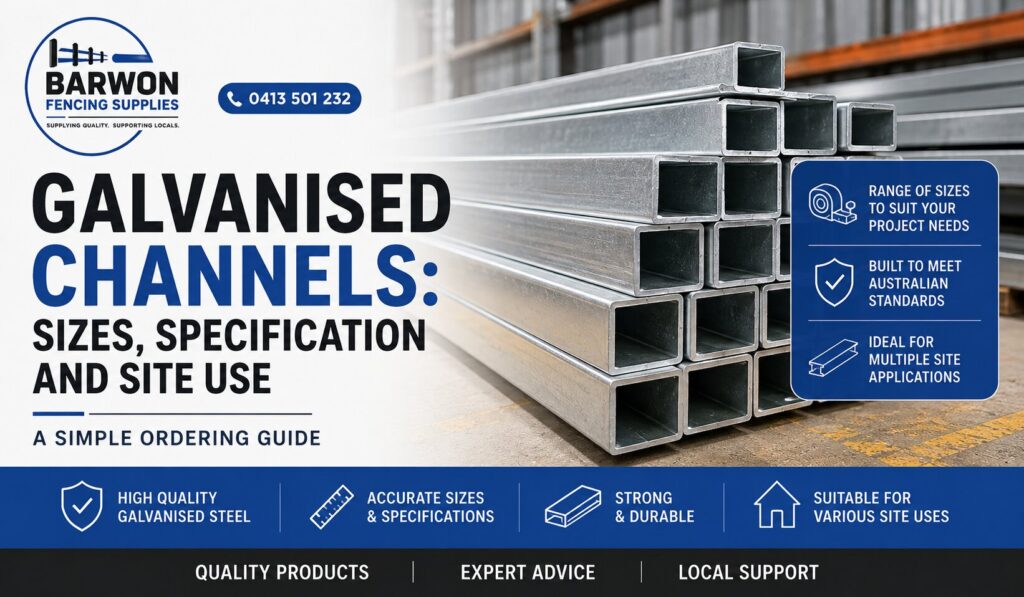
Channel is one of those sections that gets ordered on habit. Someone specifies what was used last time; it arrives, it goes in, and nobody thinks about it again until a coating fails early or a section turns out to be undersized for the span.
This is a working reference on specifying galvanised channel properly: how sizes are designated, what the coating standard actually requires, and the handling details that decide whether it lasts the design life.
Designation and sizing
Most structural galvanised channels supplied in Australia are parallel flange channels, hot rolled to AS/NZS 3679.1 in grade 300PLUS. The designation refers to nominal web depth in millimetres, so a 150 PFC has a 150mm web. Common depths run from 75 through to 380, with flange width, web and flange thickness and mass per metre all fixed for each size.
Two points that catch people out. First, PFC and the older taper flange channel are not interchangeable, and section properties differ. Second, depth alone does not tell you capacity. Two sections of the same depth from different runs can carry very different loads once span, restraint and load type are accounted for, so section capacity should come from the tables or an engineer, not from the eye.
Confirm currently stocked depths and lengths before scheduling. Not every size is held, and lead time on a non-stock section can be the difference between pouring on Thursday or the following week.
What the coating standard requires
Batch hot dip galvanising in Australia is covered by AS/NZS 4680. The coating is specified either by mass in grams per square metre or by thickness in microns, and the two convert directly, with one gram per square metre equal to 0.14 microns.
The important principle is that coating thickness is tied to steel section thickness. Heavier sections take a thicker coating, with the bands set out in Tables 1 and 2 of the standard, and 85 microns sits at the upper end of what the standard specifies. Thicker coatings than that are possible but need to be agreed with the galvaniser, because they are not available on every steel chemistry.
The standard also governs defects. Total damaged or uncoated area must not exceed 0.5 per cent of surface area or 250 square centimetres, whichever is the lesser, and repairs are made to Clause 8. A renovated area has to finish at least 30 microns above the local thickness requirement, using organic zinc-rich epoxy to AS/NZS 3750.9 in two coats, or an approved zinc spray.
Hot dip is not the same as in-line galvanised
This is the most common specification error worth avoiding. Batch hot dip galvanising to AS/NZS 4680 happens after fabrication, so cut ends, drilled holes and welds are all inside the coating. In-line galvanised products, covered by AS/NZS 4792, are coated during manufacture and carry a much thinner coating, and any subsequent cutting or drilling exposes bare steel.
In-line product has its place in dry, sheltered, low corrosivity applications. Substituting it into an exposed or in-ground application because the section size matched is how a twenty-year job becomes a five-year one.
Specifying for local conditions
Coating life is a function of atmospheric corrosivity, classified in AS 4312 from C1 through C5. That classification varies sharply across the region. An inland site at Waurn Ponds sits in a mild category. Anything near Corio Bay picks up marine influence, and sites near industrial emissions around the yard in Corio can sit higher again. AS/NZS 2312.2 is the guide for matching coating system to expected service life.
Zinc consumption is roughly linear, so doubling the coating roughly doubles the time to first maintenance. Where the section is going into ground contact or into a splash zone, the sensible move is to specify up rather than to plan for early replacement.
Cutting, welding and drilling
Every cut, hole and weld breaks the coating, and every one of them needs making good.
Welding galvanised steel produces zinc oxide fume, which causes metal fume fever. Grind the coating back in the weld zone, work with proper extraction or genuine cross ventilation, and never weld galvanised in an enclosed space on the assumption that an open roller door counts as airflow.
After welding or cutting, clean the area back to bare metal and repair to the standard. Cold galvanising paint straight over slag and mill scale is not a repair; it is a colour match.
Where channel earns its place
Retaining wall posts are the volume application locally, with C section at the ends and H section through the runs. The reason galvanising rather than paint is standard there is simple access. Once the wall is backfilled, the buried portion is unreachable for the life of the structure, so the coating has to be right on day one because there is no second chance at it.
Beyond retaining walls, channel turns up as lintels over openings, bearers and headers, edge form for slabs and steps, trailer and plant chassis, machinery skids, and framing for gates and access platforms.
On concreting jobs, it often lands in the same order as concrete mesh and starter bars, which is worth remembering when you are putting a delivery together rather than making two trips.
Ordering checklist
- Section designation and grade, not just depth.
- Coating standard stated: AS/NZS 4680 batch hot dip, not in-line.
- Cut lengths confirmed, including allowance for repair at cut ends.
- Corrosivity category for the site, and whether any part is in ground or in a splash zone.
- Access and lifting on site, because galvanised sections are heavier than the drawing suggests.
Examples of channel in service across a range of jobs are shown in our completed work.
FAQs
Can galvanised channel be painted or powder coated?
Yes, but preparation decides the outcome. New galvanising is too smooth and too reactive for paint to key properly, so it needs either weathering, a sweep or brush blast, or an etch primer and a compatible system. Powder coating requires the galvaniser to know in advance, since surface finish and any passivation treatment affect adhesion. Specify the intended finish at order stage rather than after delivery.
What happens if galvanised steel is cast into concrete?
Zinc reacts with the alkalinity of fresh concrete and gases slightly during curing, which is normal and generally not a problem for the embedded portion. The failure point is the interface at the concrete surface, where moisture, oxygen and chlorides concentrate. That zone deserves the most attention when detailing, and it is where coating thickness is worth increasing.
How do I work out expected coating life?
Take the coating thickness in microns and divide by the annual zinc loss rate for the corrosivity category from AS 4312, which gives a working estimate to first maintenance. AS/NZS 2312.2 sets out the method properly. The result is an estimate rather than a warranty, and local factors like sheltered unwashed surfaces or trapped moisture will shorten it.
Is a white powdery deposit on new stock a defect?
That is a wet storage stain, zinc oxide formed where bundled material has been stored damp without airflow. Light staining is cosmetic and will weather off with negligible loss of coating. Heavy staining with dark or blistered coating underneath is another matter and should be assessed before installation. Store material off the ground, angled to drain, with airflow between sections.
Can I mix galvanised channel with other metals?
Be careful with fasteners and contact surfaces. Pairing zinc-coated steel with copper or with untreated stainless in a wet environment sets up galvanic corrosion, and the zinc gives way first. Use galvanised fasteners to AS/NZS 1214 where possible, and isolate dissimilar metals where they must meet.
Talk to Barwon Fencing Supplies Today
If you are pricing a job and want the steel component sorted in one call, send through the schedule. We can check sizes against what is on the racks, flag anything that will need ordering in, and have it cut and ready for pickup or delivery.
Barwon Fencing Supplies supplies trade and commercial customers across Greater Geelong, and our team is used to working from a take-off rather than a shopping list.
Call 0413 501 232, email sales@barwonfencingsupplies.com.au, or come into 92 O’Briens Road, Corio VIC 3214. Full range at barwonfencingsupplies.com.au.