
How Deep Should Fence Posts Go?
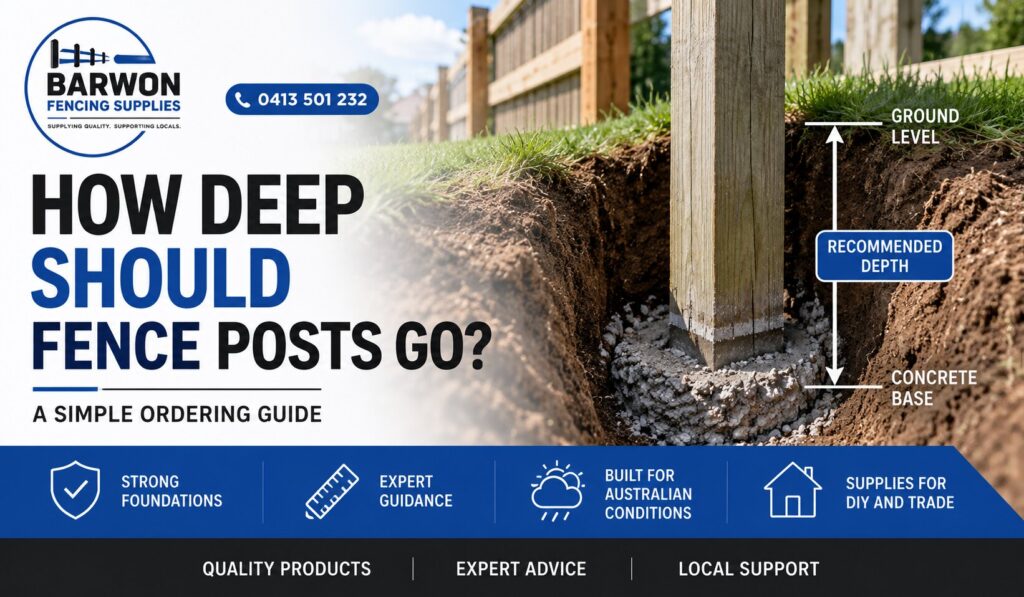
Almost every leaning fence in Geelong is a footing problem. The palings are fine, the rails are fine, and the whole thing is slowly rotating because the posts were never deep enough to resist the leverage working on them.
There is a standard answer to how deep posts should go, and it is a reasonable starting point. What matters more is knowing when your site is one of the many around here where that answer is not enough.
The default depth
The Australian rule of thumb is to bury one third of the post’s above ground height, with 600mm treated as an absolute minimum regardless of how low the fence is.
| Fence height | Typical depth in stable ground |
| Up to 1.2m | 600mm minimum |
| 1.5m | 600mm |
| 1.8m, the standard boundary fence | 600mm |
| 2.1m to 2.4m | 750mm or more |
| Gate and corner posts | Add 150mm to 300mm to the above |
These figures assume firm natural clay or loam and a concrete set post. They also assume the post itself is rated for the job. For timber fence posts, that means a preservative treatment rated for in-ground contact under AS 1604. Posts rated only for above ground use will fail at the soil line no matter how deep you put them, and that single substitution is behind a large share of early fence failures.
Why a fence leans
A fence is a sail. Wind pushes on the panel, and that force becomes a rotating moment concentrated right at ground level. The buried section of post and the concrete around it resist that rotation by bearing against the soil.
Two things decide whether they win. Depth gives you leverage, since a longer buried section spreads the same load over more soil. Soil strength gives you resistance, and that is the variable that changes most across the region.
Panel type feeds straight into this. A solid steel fence catches close to the full wind load, while a timber paling fence with gaps between boards lets some of it through. That is part of why solid panels on an exposed western block are worth treating as a deeper footing job than the same height fence in a sheltered street.
Post spacing matters too. Wider spacings put more panel area onto each post, so stretching centres out to save a post or two quietly increases the load on every remaining one.
What is actually under a Geelong block
Sites are classified under AS 2870, running from stable sand and rock through to highly reactive clay. Around Greater Geelong you commonly strike:
- Reactive clay. Good holding once set, but it swells and shrinks with moisture, which works posts loose over years. Standard depths work provided water is not pooling at the base.
- Sand and loose fill. Poor bearing. Go deeper, around 900mm for a 1.8m fence, and flare the bottom of the hole wider than the top so the footing cannot be pulled straight up.
- Hard digging, excellent holding. A shallower socket can work, but reaching depth may need an auger or a jackhammer.
- Imported fill. The one that causes the most trouble, covered next.
The fill trap in newer estates
Blocks across the growth corridors have been shaped by cut and fill, so a slab may sit on engineered fill a metre or more above natural ground. In estates like Armstrong Creek, hitting 600mm can mean you are still entirely in fill.
Fill placed around lot boundaries is often not compacted to the same standard as the building platform. A post set only in loose fill has nothing solid to bear against, and the fence will move even though the depth on paper was correct.
The rule on these sites is to keep going until you reach undisturbed natural ground, whatever the tape says. That can mean 800mm or more. It is extra work on day one and it is the difference between a fence that stays plumb and one that needs redoing.
Hole diameter and concrete
Diameter matters nearly as much as depth. Aim for roughly three times the post width, which for typical fencing posts puts you around 200mm to 300mm. A narrow hole wraps the post in a thin collar that cracks under load.
Use a structural mix rather than a dry sand and cement blend, and let it do the work it is designed for. Rapid set products are convenient for Colorbond fence systems and light panels, though on a long run the time saved is smaller than it looks once digging and setting out are counted.
Two finishing details. Crown the concrete slightly above ground so water runs away from the post rather than sitting against it. And do not backfill the top with soil, which traps moisture exactly where timber and coatings are most vulnerable.
Gates, corners and ends
Any post carrying a gate takes cyclic load every time it swings, plus the dead weight of the leaf hanging off one side. Corner and end posts carry pull from two directions with nothing balancing them.
All of these want more depth, a larger diameter footing and, for wide or heavy gates, a properly sized post section. Undersizing a gate post is the most visible mistake on a fence, because the sag shows up in the gap along the closing edge within a season.
Before you hang anything
Let the footings cure before loading them. Setting posts and fixing panels on the same day builds movement into the fence while the concrete is still gaining strength, and that movement never comes back out. A full day is a sensible minimum, and longer in cold weather.
FAQs
Can I set posts without concrete?
For light rural fencing and star pickets, rammed earth or compacted crushed rock is normal practice and works because the loads are low. For a 1.8 metre suburban boundary fence, concrete is the sensible choice. Compacted road base can perform well in free-draining soil and has the advantage of being easier to remove later, but it needs real compaction in layers rather than shovelling material in and hoping. In reactive clay, concrete is the more reliable option.
Should I put gravel in the bottom of the hole?
Opinions differ, and both approaches have merit. A layer of crushed rock under a timber post lets water drain away from the end grain instead of sitting against it. The counterargument is that in clay the gravel becomes a small sump with nowhere to drain, which is worse than no gravel at all. As a general guide, use it in free-draining soil and skip it in heavy clay, where a crowned concrete surface does more good.
How long before I can fix panels or palings?
Give the concrete at least 24 hours before applying any load, and longer if it has been cold or wet. Most footings reach usable strength well before full cure, but the risk is not the concrete failing; it is the post shifting a few millimetres while you are pulling a line tight. On a long fence, that small movement compounds into a visibly wandering top rail.
What if I hit rock before reaching depth?
Stop and reassess rather than accepting a shallow hole. Options include coring or breaking out to depth with the right tool, moving the post a short distance along the line if the layout allows, or switching to a base plate fixed into the rock with masonry anchors. Rock gives excellent restraint, so a shorter socket into solid rock can outperform a deeper hole in soft ground, but it needs to be a deliberate choice.
Can I reuse the old holes when replacing a fence?
Rarely worth it. Old holes are usually full of degraded concrete and disturbed soil, which is the weakest possible material to set a new post into. If the previous posts were undersized, reusing their positions also repeats whatever spacing caused the problem. Break out the old footings properly and dig fresh, ideally offsetting slightly from the original positions.
Find What You Need at Barwon
Post depth changes how much you need to buy. Deeper holes mean longer posts and more concrete, and running short partway down a boundary on a Saturday afternoon is a frustrating way to lose a weekend.
Tell us your fence length, the height you are after and what the ground is like, and our team can work out post quantities, spacings and how much concrete to allow before you start digging. If you are unsure what is under your block, a quick description of the street and the age of the estate usually tells us plenty.
Call 0413 501 232, email sales@barwonfencingsupplies.com.au, or visit 92 O’Brien’s Road, Corio VIC 3214. See the full range at barwonfencingsupplies.com.au.