
Who Pays For A Boundary Fence In Victoria
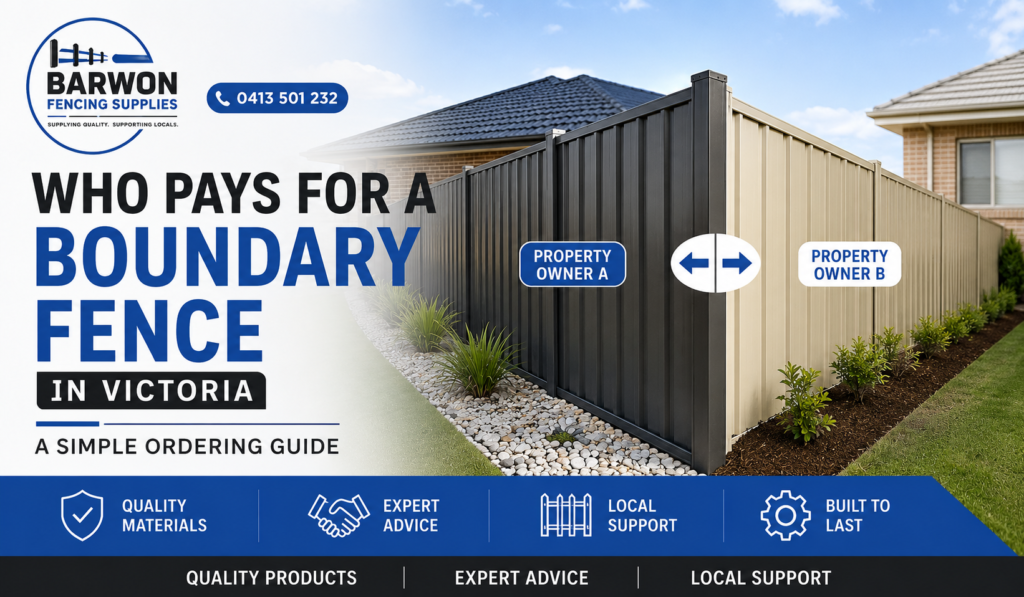
Few conversations between neighbours go sideways as quickly as the one about the fence. It usually starts politely, someone mentions a quote, and then nobody is quite sure who is supposed to pay for what.
The good news is that Victoria has clear law on this, and it has been clear since the Fences Amendment Act 2014 updated the original Fences Act 1968. Here is how it actually works, including the part that trips up most people.
The starting position is an even split
Under the Fences Act, owners of adjoining land are liable to contribute in equal proportions to a sufficient dividing fence. Fifty-fifty is the default, and it applies regardless of who wants the fence, who uses it more, or whose side looks better when it is finished.
Two details matter here. The first is that the obligation sits with the owner, not the occupier. Since 2014, the Act has been written around ownership, which means a renter next door is generally not the person you are dealing with. The second is that a dividing fence is joint property. Both owners hold equal rights and obligations in it, even where the fence does not sit exactly on the title line.
Unless it is impractical, the fence should be built on the common boundary. Building it elsewhere can open the door to adverse possession claims down the track, which is a far bigger problem than the fence itself.
What counts as a sufficient fence
The Act does not name a height or a material. Instead it lists factors for working out what is sufficient in your particular situation: any existing dividing fence, how both owners use their land, reasonable privacy concerns, and the kinds of fences commonly used in the local area.
In practice, across most suburban Geelong streets, that lands on a standard timber paling fence at around 1.8 metres. On a rural block outside Lara or Curlewis, a sufficient fence might be post and wire, because that is what the land is used for and what the neighbourhood uses. Context does the work, not a fixed rule.
The fencing notice and the 30-day rule
If you want your neighbour to contribute, the formal step is a fencing notice. It is a prescribed form under the Fences Regulations 2024, and it sets out what you are proposing: the boundary line, the type of fence, the works involved, contractor details and how costs should be split. Send it by registered post so there is proof of when it was received.
Your neighbour then has 30 days. Attaching at least one written quote makes agreement far more likely, which is why most people get pricing organised across Greater Geelong before the notice goes out rather than after.
Here is the part almost everyone gets wrong. If your neighbour responds within 30 days and does not agree, you cannot simply go ahead. You must reach agreement or obtain an order from the Magistrates’ Court first. Starting work anyway can leave you exposed.
Only silence gives you the right to proceed. If 30 days pass with no response at all, you may carry out the works and then pursue their contribution through the Magistrates’ Court afterwards.
When one owner pays more than half
The even split covers a sufficient fence and nothing beyond it. If one owner wants something of a higher standard, taller, or made from a more expensive material, that owner pays the difference between the sufficient fence and the upgrade.
A common example: the neighbourhood standard is timber palings, but you would prefer Colorbond fencing for the lower maintenance and the acoustic benefit. Your neighbour still contributes half the cost of the sufficient fence, and you cover the gap. Worth raising early, because it often turns a stalled conversation into an easy yes.
Damage works differently again. Where one owner, or someone they are responsible for, damages or destroys the fence, that owner carries the full cost of putting it right.
Which side the rails and framing face
The Act covers this, and it settles an argument that has been running in Australian backyards for decades.
Owners can simply agree which side the rails go on. Where there is no agreement and no court order, the default applies. For a fence between residential and commercial land and an area of public access or a right of way, the rails face into the residential or commercial land. In all other cases, rails go on the same side as the previous fence where a similar fence is being replaced, or on the side least subject to weathering where the fence type is changing, or there was no fence before.
When the boundary itself is unclear
Sometimes the disagreement is not about money at all; it is about where the line actually runs. The Act has a separate process for this, starting with a boundary survey notice. Only a licensed surveyor can define a boundary under the Surveying Act 2004, and the cost of that survey is generally shared. Court action about the fence is put on hold while the boundary is being established.
Three exceptions worth knowing
- Urgent works. Where a fence has been damaged or destroyed, and it is impractical to give notice first, for example after a storm brings a tree down, you can carry out urgent works and serve an urgent fencing notice afterwards to recover the contribution.
- Long-term tenants. In limited circumstances, a tenant with a long unexpired lease term can become liable for part or all of the landlord’s share. This applies to long commercial style leases, not standard residential tenancies.
- Crown land. The Act does not apply to unalienated Crown land, so a boundary with certain public land will not attract a contribution.
None of this is legal advice, and every boundary has its own quirks. The Dispute Settlement Centre of Victoria offers free assistance, and the City of Greater Geelong can point you to the right process for your street.
FAQs
What if my neighbour simply refuses to pay?
If they responded to your fencing notice and disagreed, the next step is negotiation, then mediation through the Dispute Settlement Centre of Victoria, and finally an application to the Magistrates’ Court for an order. If they never responded at all within the 30 days, you can proceed with the works as set out in your notice and recover their share through the court afterwards. Keep every document, because the paperwork trail is what the court will look at.
Do I need a building permit to replace a dividing fence?
A standard dividing fence between two residential properties usually does not require a building permit. There are important exceptions. Swimming pool safety barriers are regulated separately and have their own strict requirements. Front fences can also be affected by planning scheme height limits or by an overlay on the property. If your fence is on a street frontage, near a corner, or part of a pool enclosure, check with the City of Greater Geelong before ordering.
My neighbour’s tree fell and destroyed the fence. Who pays?
If the damage resulted from something that the owner was responsible for, the Act makes them liable for the full cost of repair rather than half. In practice, this can be contested, since a healthy tree brought down by an unusually severe storm is treated differently from one that was obviously dead or neglected. Photograph everything before you clear it away.
The fence is on my land, not the boundary. Does that change anything?
Not as much as people expect. Both owners retain equal rights and obligations for a dividing fence even where it does not sit precisely on the common boundary. What it can change is the risk of an adverse possession claim over time, which is why replacing a misplaced fence is usually the moment to sort the line out properly with a survey.
Can I start work while waiting for my neighbour to reply?
Not if you want them to contribute. The 30-day window exists for a reason, and beginning work before it closes undermines your position. The one exception is genuinely urgent work where the fence is already down and leaving it is not practical.
Get Started with Barwon Fencing Supplies
A fencing notice lands far better when there is a real quote attached to it. Vague figures invite argument, while an itemised cost for a specific fence, in a specific material, at a specific height gives your neighbour something concrete to say yes to.
Barwon Fencing Supplies can help you put those numbers together. Our team knows what a standard fence looks like street by street across the region, and we can price the fencing materials for a straight replacement alongside an upgrade option, so you can see exactly what the difference would be before the conversation starts.
Call 0413 501 232, email sales@barwonfencingsupplies.com.au, or visit us at 92 O’Briens Road, Corio VIC 3214. Full product range at barwonfencingsupplies.com.au.